Structured Problem Solving Training Malaysia — A Repeatable Framework Every Manager Can Use
Most teams attack problems with the wrong tool, or solve the wrong problem entirely. This structured problem solving training Malaysia gives managers, team leaders, and operations professionals a clear, repeatable process — from problem definition to permanent fix.
Enquire Now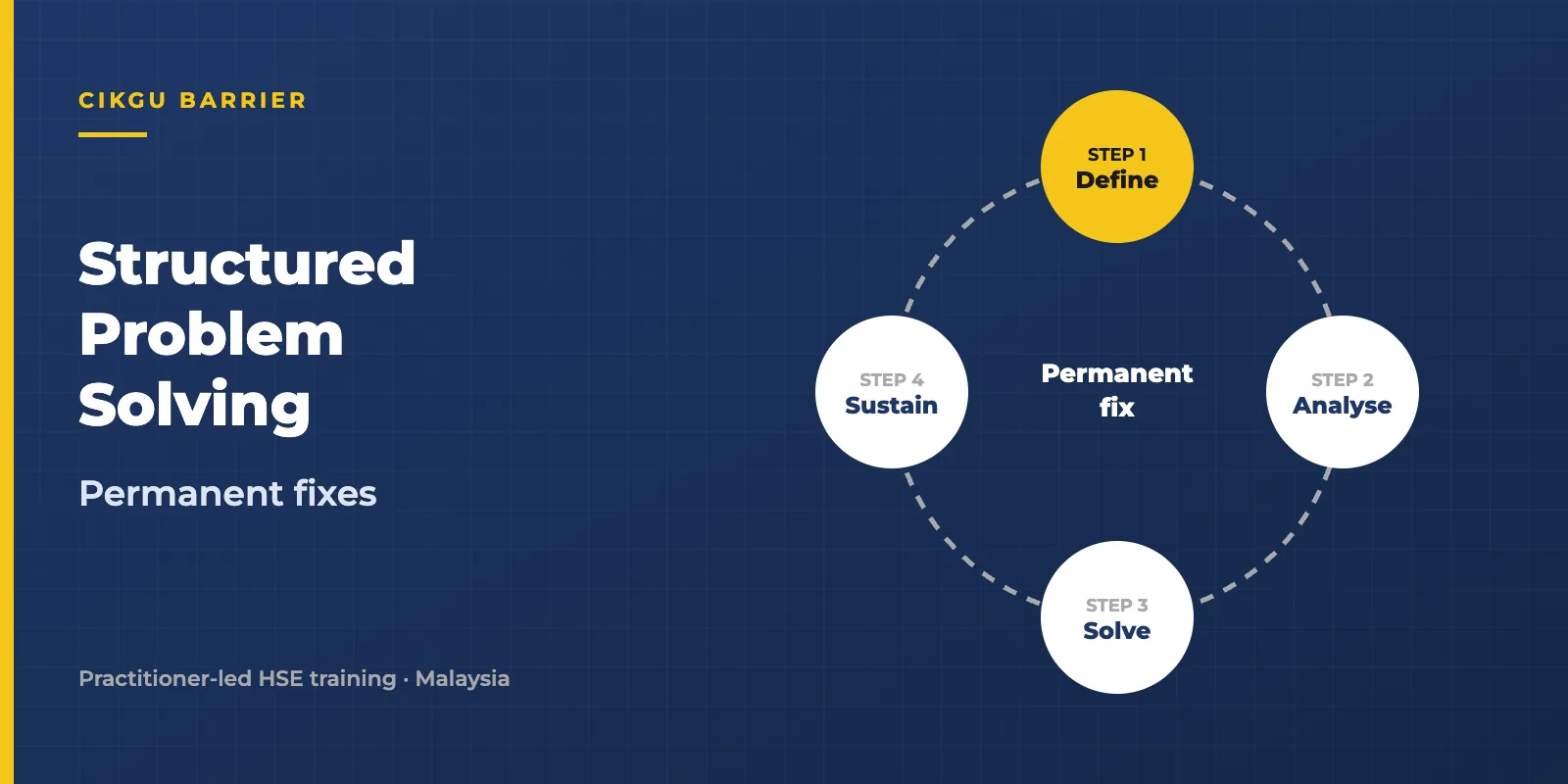
Who Should Attend
Who Should Attend This Structured Problem Solving Training
This structured problem solving training Malaysia is for anyone who leads people, manages processes, or is expected to fix things when they go wrong — and wants a method that works consistently.
Operations Managers & Team Leaders
Dealing with recurring operational problems — delays, defects, complaints, or process breakdowns. Learn a structured approach to solve problems once instead of chasing them every week.
L&D Managers & Training Coordinators
Embedding problem-solving capability across your organisation. This program gives your managers a shared, consistent method — so teams aren't each making it up as they go.
Department Heads & Senior Managers
Setting standards for how problems are escalated, analysed, and resolved across your function. Learn how to review improvement plans and spot whether solutions are actually addressing the right things.
What You Will Learn
Walk Away With a Framework for Every Problem You Face
This structured problem solving training Malaysia is built around one outcome: you can look at any problem your team is dealing with, define it precisely, analyse it systematically, and design a solution that holds. Including identifying where your current improvement plans need to be strengthened.
- Define any operational problem clearly — with scope, boundaries, and a measurable impact statement
- Use structured analysis tools to find real causes rather than the most obvious explanation
- Select the right problem-solving tool for the situation — not default to one method every time
- Generate solution options systematically and evaluate them on feasibility and permanence
- Distinguish between quick fixes, corrective actions, and systemic improvements
- Identify which improvement plans in your organisation are treating symptoms, not causes
- Build a structured problem-solving record that is reviewable, trackable, and transferable
- Apply the framework independently after the training — no coach or facilitator required
The Real Cost of Unstructured Problem Solving
When a problem surfaces, the pressure to resolve it quickly is real. But speed without structure produces solutions that work for a week. The same problem comes back — with extra urgency, more damage, and less goodwill. Structured problem solving training Malaysia does not slow you down. It stops you from wasting time solving the wrong thing twice. A manager who can define a problem clearly, analyse it systematically, and act on evidence — not instinct — is a manager who builds trust and produces results that last.
Program Outline
Structured Problem Solving Training Malaysia — What We Cover
Available as a half-day (4-hour) or full-day (7-hour) program. The full-day version includes extended practicals using real problems from participants' own work contexts.
Module 1
The Problem-Solving Trap Foundation
- Why smart teams keep solving the wrong problem — and what drives it
- The three most common problem-solving errors: jumping to solutions, misdefining the problem, and treating the symptom
- What "structured" actually means — and why it matters more than experience
- How the absence of a shared method across a team multiplies problem-solving failures
Module 2
Defining the Real Problem Problem Definition
- Writing a problem statement: what it must include and what kills it
- Is / Is Not analysis: scoping the problem by defining where it does and does not occur
- Separating the problem from its assumed cause — the single most important skill in this program
- Quantifying impact: frequency, severity, and business consequence
- Practical: Participants rewrite a vague problem statement into a precise, solvable one
Module 3
Structured Analysis — Finding the Cause Analysis
- 5-Why: correct application, common misuse, and when to stop
- Fishbone analysis: mapping contributing causes across multiple categories
- Barrier thinking: what should have prevented this and why it didn't
- Evidence vs. assumption: the discipline of only drawing conclusions from data
- Choosing the right tool for the type of problem you're facing
- Practical: Group analysis exercise on an operational case study
Module 4
Designing Solutions That Stick Solution Design
- Generating solution options: divergent thinking before convergent decision-making
- Evaluating solutions: feasibility, permanence, and unintended consequences
- Hierarchy of controls — why "retrain staff" is rarely the right answer
- Writing action plans that are specific, assigned, time-bound, and verifiable
- The difference between a quick fix, a corrective action, and a systemic improvement
Module 5
Reviewing Your Improvement Plans Application
- How to audit your current action register and identify symptom-level fixes
- Spotting where your improvement plans need to be strengthened — before problems recur
- Measuring effectiveness: what "solved" actually means and how to verify it
- Applying the framework as a team standard — consistency across shifts, departments, and managers
- Full-day only: Participants apply the full framework to a real problem from their own context
How It's Delivered
Flexible Delivery for Every Team
Choose the format that fits your situation. All three options cover the same content. In-house sessions use problems from your team's actual context for the practicals.
In-House (On-Site)
Run at your workplace for your team. Practicals use real operational problems from your environment — making every exercise directly applicable from day one.
Public Workshop
Open-registration sessions. Attend individually or as a small team. Scheduled dates announced via LinkedIn and the website.
Virtual / Online
Live instructor-led session via video call. Includes digital worksheets and real-time group exercises. Suitable for remote and multi-location teams.
Investment
Pricing Available on Request
Every engagement is scoped differently — team size, duration, location, and delivery format all affect the final number. Contact us for a quote tailored to your requirements. We respond within 1 business day.
Public Workshop
Open enrolment sessions. Contact us for upcoming dates and per-participant pricing.
In-House / On-Site
We come to your workplace. Quoted per engagement based on group size, duration, and location.
Virtual / VILT
Live trainer-led online delivery. Contact us for scheduling and group pricing options.
WhatsApp +60 12-983 1120 or use the enquiry form below — we respond within 1 business day.
Deeper Analysis for Complex or High-Stakes Problems?
If your team is dealing with incidents — serious failures, accidents, or near-misses with multiple contributing causes — the Root Cause Analysis for Operations program adds structured investigation frameworks specific to failure analysis. For complex, multi-causal incidents, the Tripod Beta Incident Investigation program is the advanced methodology used by leading industrial organisations.
Common Questions
Frequently Asked Questions
How is this different from a general management or leadership training course?
This structured problem solving training Malaysia is not a soft-skills program. It is a practical, tool-based course that teaches a specific, repeatable process for analysing and resolving operational problems. Participants leave with a framework they can apply the next day — not a set of principles to reflect on.
Is this the same as Lean or Six Sigma problem solving?
The tools taught here (5-Why, Fishbone, Is/Is Not) are foundational across Lean, Six Sigma, and ISO quality management frameworks. This program does not teach Lean or Six Sigma certification. It teaches the structured thinking skills that make those frameworks effective when your team actually uses them.
Can this be run for a mixed group — some managers, some team leaders?
Yes, and it works well that way. When managers and team leaders learn the same framework together, problem escalations improve, review conversations become cleaner, and improvement plans are easier to evaluate. Mixed groups are common in in-house delivery.
Is this training claimable under HRD Corp?
Yes. Cikgu Barrier Solutions is an HRD Corp registered training provider (TP Serial No. 202603118741), so Malaysian employers can claim this program under the HRD Corp levy scheme, subject to HRD Corp grant approval.
Get Started
Ready to Give Your Team a Problem-Solving Standard?
Send an enquiry and we will get back to you within one working day with available dates and a quote for your team.
Enquire Now Or WhatsApp directly: +60 12-983 1120