Risk-Based Decision Making Training Malaysia — Better Calls Under Pressure
Managers make dozens of decisions a day — many under time pressure, with incomplete information, and real consequences. This risk-based decision making training Malaysia gives you a structured framework to make better calls, explain your reasoning, and build improvement plans that actually account for what can go wrong.
Enquire Now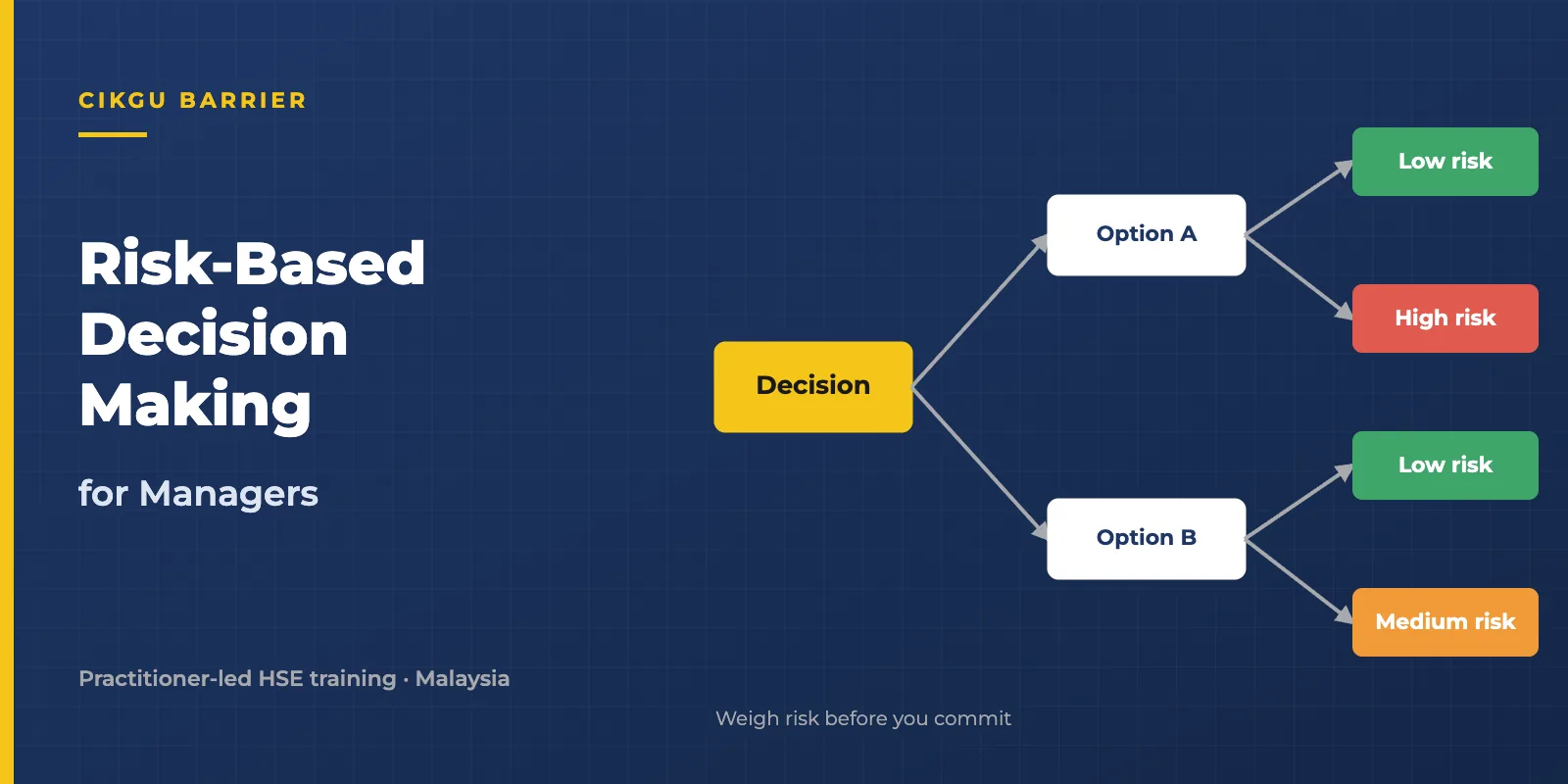
Who Should Attend
Who Should Attend This Risk-Based Decision Making Training
This risk-based decision making training Malaysia is for leaders who are accountable for outcomes — and who want a structured way to make calls that hold up under scrutiny, even when the information is incomplete and the clock is running.
Senior Managers & Operations Directors
Responsible for decisions with significant operational, financial, or reputational consequences. Build a structured approach to evaluating options and making calls you can stand behind.
Project Managers & Department Heads
Making resource, schedule, and scope decisions with limited information and competing priorities. Learn to evaluate risk explicitly instead of relying on gut feel and hoping for the best.
L&D Managers Building Leadership Capability
Developing your management pipeline's decision-making competency. This program gives future leaders a structured framework — not just confidence, but a process they can repeat and improve.
What You Will Learn
Walk Away Making Better Calls — With a Process to Show Your Work
After this risk-based decision making training Malaysia, you will be able to structure any significant decision, make the risk trade-offs explicit, and identify where your current improvement plans and operating procedures need to be strengthened before something goes wrong.
- Identify the cognitive traps that corrupt decisions under pressure — and how to neutralise them
- Apply a structured decision-making framework to any significant operational or management decision
- Define the decision clearly: what exactly is being decided, by whom, and on what criteria
- Evaluate options against explicit risk criteria — not just cost and speed
- Understand how risk tolerance affects decision quality at different levels of the organisation
- Use barrier thinking to identify what could go wrong with a decision and how to protect against it
- Review your improvement plans to identify where risk has not been adequately considered
- Document decision rationale in a way that is reviewable, defensible, and transferable
Why "Experience" Is Not Enough for High-Stakes Decisions
Experienced managers make poor decisions too — not because they lack knowledge, but because experience builds confidence faster than it builds rigour. Under pressure, the brain shortcuts. It anchors on the first plausible option, discounts low-probability risks, and mistakes familiarity for correctness. Risk-based decision making training Malaysia does not replace experience — it gives experience a structure. When you know how to define the decision, surface the risks explicitly, and evaluate options against clear criteria, you make better calls and you can explain exactly why. That combination — good decision plus clear rationale — is what separates leaders who build trust from leaders who generate uncertainty.
Program Outline
Risk-Based Decision Making Training Malaysia — What We Cover
Available as a half-day (4-hour) or full-day (7-hour) program. The full-day version includes extended case studies and a group decision simulation using a realistic operational scenario.
Module 1
Why Managers Make the Wrong Call Foundation
- Decision quality vs. decision outcome — why good decisions sometimes produce bad results
- The five cognitive traps that corrupt management decisions: anchoring, confirmation bias, availability bias, escalation of commitment, and groupthink
- How time pressure and incomplete information amplify decision errors
- The cost of poor decisions that aren't recognised as decisions — drifting into outcomes by default
- Reference: ISO 31000 risk management principles applied to everyday management decisions
Module 2
How Risk Shapes Decisions Risk Thinking
- What risk means in a decision context — likelihood, consequence, and controllability
- Risk tolerance vs. risk appetite: how your organisation's thresholds should shape your choices
- The difference between acceptable risk, manageable risk, and unacceptable risk
- How decisions made under uncertainty are fundamentally different from decisions made with full information — and what to do about it
- Barrier thinking: for every option, what barriers exist — and which are missing
Module 3
A Structured Framework for Any Decision Framework
- Step 1 — Define the decision: what is actually being decided, what the boundaries are, and who is accountable
- Step 2 — Identify the options: generating alternatives rather than defaulting to the obvious
- Step 3 — Surface the risks: what could go wrong with each option, and how likely and severe is it
- Step 4 — Evaluate against criteria: using a consistent evaluation matrix to compare options
- Step 5 — Decide and document: making the call and recording the rationale
- Practical: Participants work through the full framework on a realistic management scenario
Module 4
Deciding Under Pressure — Time, Incomplete Information, and Escalation Application
- How to apply a structured approach when you do not have the luxury of time
- What to do when information is incomplete — and how to avoid false certainty
- When to escalate vs. when to decide — the accountability boundary problem
- Escalation of commitment: how to recognise when you are doubling down on a failing decision
- Building a decision brief: communicating a decision and its rationale to stakeholders clearly
Module 5
Strengthening Your Improvement Plans Review
- How to review existing improvement plans and identify where risk has not been adequately considered
- Spotting decisions that were made implicitly — and the risk gaps they left open
- Embedding risk thinking into operational planning, change management, and project kick-offs
- Building a team decision culture: consistency, accountability, and continuous improvement
- Full-day only: Group decision simulation — participants manage a realistic operational crisis scenario using the framework
How It's Delivered
Flexible Delivery for Every Team
Choose the format that fits your situation. All three options cover the same content. In-house delivery uses decision scenarios from your industry and business context.
In-House (On-Site)
Run at your workplace for your management team. Decision scenarios are drawn from your industry and real operational context — making every exercise directly relevant to decisions your managers face.
Public Workshop
Open-registration sessions for individual managers or small leadership groups. Scheduled dates announced via LinkedIn and the website.
Virtual / Online
Live instructor-led session via video call. Suitable for leadership teams spread across multiple sites. Includes digital worksheets and group decision exercises.
Investment
Pricing Available on Request
Every engagement is scoped differently — team size, duration, location, and delivery format all affect the final number. Contact us for a quote tailored to your requirements. We respond within 1 business day.
Public Workshop
Open enrolment sessions. Contact us for upcoming dates and per-participant pricing.
In-House / On-Site
We come to your workplace. Quoted per engagement based on group size, duration, and location.
Virtual / VILT
Live trainer-led online delivery. Contact us for scheduling and group pricing options.
WhatsApp +60 12-983 1120 or use the enquiry form below — we respond within 1 business day.
Want the Advanced Visual Risk Tool — Bowtie Analysis?
This program teaches structured decision making with risk as the lens. If your team also needs a visual risk modelling tool for complex operations — mapping threats, consequences, and barriers — the Barrier Management: Bowtie Analysis program is the advanced methodology. Many senior managers attend both: decision making first, then Bowtie for deep-dive risk visualisation.
Common Questions
Frequently Asked Questions
Is this a risk management course?
It uses risk management thinking — specifically the principle that every decision is a choice about which risks to accept — but it is not a risk management certification course. This risk-based decision making training Malaysia is about applying risk thinking to everyday management decisions: resourcing, change management, operational trade-offs, and improvement planning. If you need a structured risk assessment methodology, see our HIRARC Training or Bowtie Analysis programs.
Is this suitable for first-time managers or only senior leaders?
It works best for managers who already make consequential decisions — typically team leaders, department heads, operations managers, and above. First-time managers who are stepping into decision accountability will benefit, but the program assumes participants have real decisions to bring to the room. The more senior the group, the richer the case study discussions.
Can this be run as part of a broader leadership development programme?
Yes — this is one of the most common use cases for in-house delivery. It slots well into leadership pipeline programs, management development curricula, or operational excellence initiatives. Contact us to discuss how it can be sequenced with your existing training.
Is this training claimable under HRD Corp?
Yes. Cikgu Barrier Solutions is an HRD Corp registered training provider (TP Serial No. 202603118741), so Malaysian employers can claim this program under the HRD Corp levy scheme, subject to HRD Corp grant approval.
Get Started
Ready to Build a Stronger Decision-Making Standard?
Send an enquiry and we will get back to you within one working day with available dates and a quote for your management team.
Enquire Now Or WhatsApp directly: +60 12-983 1120